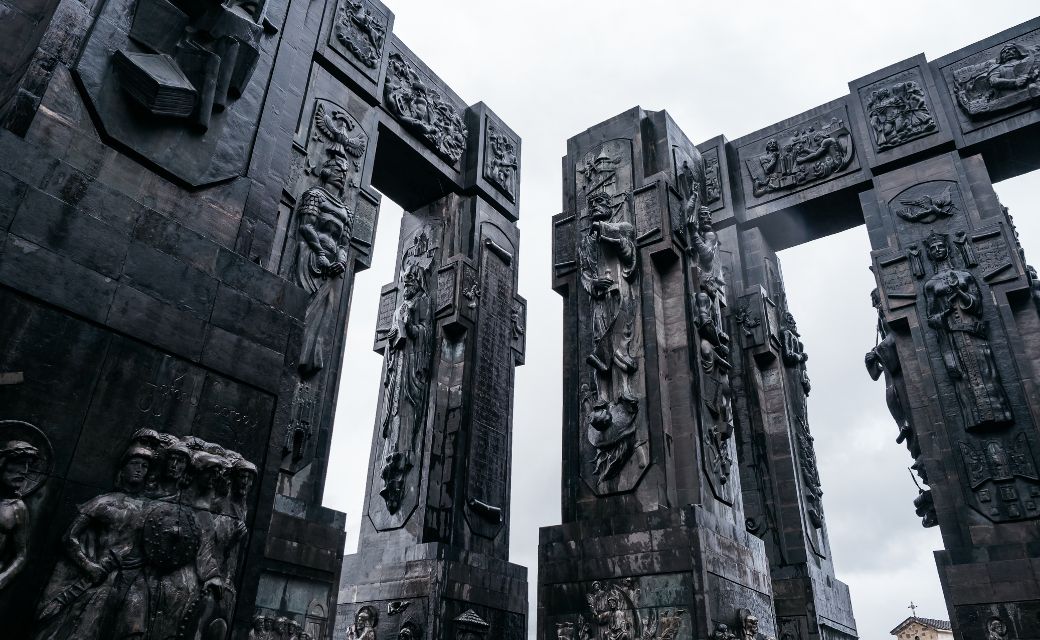
On Keeni Hill above the Tbilisi Sea, bronze-clad pillars catch the light. The Chronicle of Georgia, nicknamed the Stonehenge of Georgia, stands around an open central space: sixteen columns, each 35 metres high. Sculptor Zurab Tsereteli began the project in 1985; funding problems and later conflict are often cited as reasons it remains unfinished.
The upper panels show Georgian monarchs and heroes; below, scenes from Christ’s life evoke Georgia’s Christian heritage. Queen Tamar recalls the medieval kingdom’s Golden Age, while poet Shota Rustaveli represents its literary tradition. The monument was conceived to honour 3,000 years of statehood and 2,000 years of Christianity.
Walk between the pillars and carved figures seem to emerge from the stone. Nearby, a grapevine cross recalls St Nino, credited with bringing Christianity to Georgia, and a small church sits behind the monument. From the hilltop, the reservoir and northern suburbs stretch into view.
Unfinished yet imposing, the memorial holds Georgia’s past in stone and metal. Looking up, you can almost imagine its next chapter waiting to be carved.