What began in the late 19th century as a modest effort to foster national unity has grown into the Netherlands’ most distinctive annual celebration. Beneath the colour and music is carefully orchestrated chaos. This celebration holds a history shaped by monarchy, shifting public sentiment, and the gradual formation of a shared national identity.
This national observance can be traced to the 1880s, when limited public enthusiasm for King William III led attention to shift toward his young daughter, Princess Wilhelmina. Her birthday, on 31 August, was first celebrated as Prinsessedag in 1885. It began in Utrecht with children’s parades and small civic festivities. What started locally quickly spread across the country and evolved into a national observance. When Wilhelmina became queen in 1890, the day was renamed Queen’s Day. This laid the foundation for what would become Koningsdag.
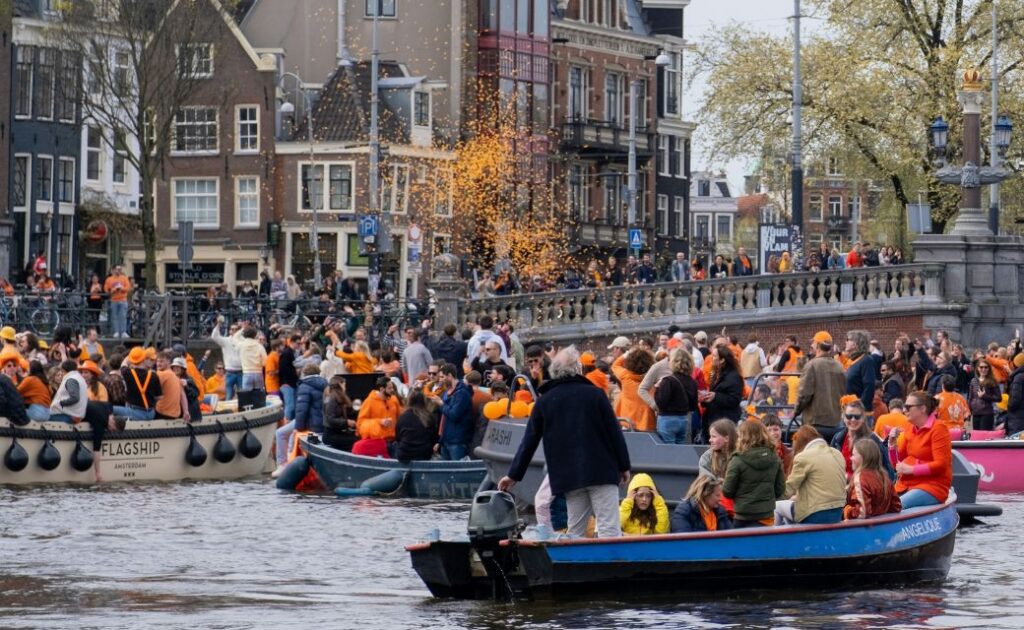
Building on this legacy, today Koningsdag is celebrated nationwide on 27 April in honour of King Willem-Alexander’s birthday. The entire country participates at once, with streets turning into open-air gatherings, music filling public spaces, and canals, especially in Amsterdam, becoming moving stages of celebration. A sea of orange, referencing the House of Orange-Nassau, visually unites cities and towns.
One of the day’s defining traditions is the vrijmarkt, where regulations are relaxed, and anyone can set up a street stall, blurring the line between public space and private enterprise. Should the 27th fall on a Sunday, festivities are brought forward to 26 April, preserving the Netherlands’ quieter Sundays.
More than a public holiday, Koningsdag is a moment of national expression, capturing Dutch culture at its most open, social, and celebratory.