What began in 1847 as a modest livestock fair has evolved into one of Spain’s most iconic and sought-after social gatherings. Beneath the surface of its vibrant energy lies a more discreet reality: a world defined not by access, but by invitation.
By the late 19th century, the fair had shed its commercial roots in favour of culture and connection. Today, a temporary city rises across 450,000 square metres – an intricate tapestry of over 1,000 casetas, lantern-lit streets, and hidden courtyards. Yet for all its scale, much of the experience remains behind closed doors. Privately owned by families, businesses, and social circles, these casetas form the true heart of the feria — intimate spaces where relationships are forged, stories are shared, and the real essence of Seville quietly unfolds.
For one extraordinary week, the city welcomes close to five million visitors, with daily crowds swelling to half a million and peak evenings reaching far beyond. And yet, within this vast celebration, there exists a parallel, more refined world — one that reveals itself only to those invited in.
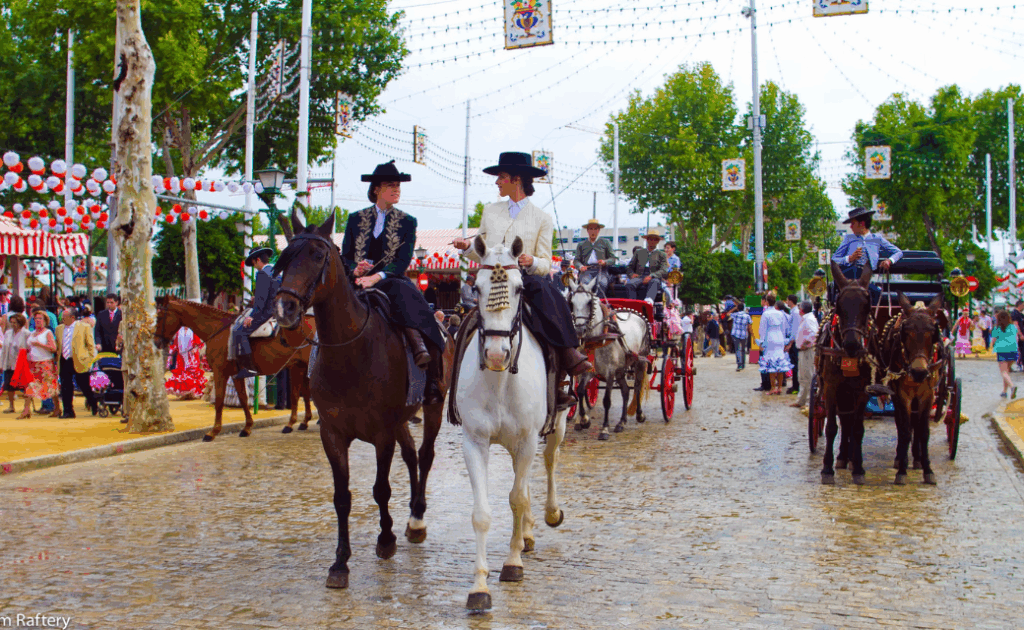
The festivities begin with the alumbrao, as thousands of lights ignite the night sky at midnight on Monday, unveiling the fair in a moment of pure theatre. By day, Seville moves to a different rhythm; horse-drawn carriages roll through the Paseo de Caballos, and locals in full flamenco dress know how to dance the Sevillanas, which is less performance, more expectation, a timeless ritual of Andalusian life. As the afternoon turns to evening, anticipation builds. And when night falls, the feria transforms — the lights glow warmer, the music deepens, and behind the doors of the casetas, the true celebration begins.
Then, almost as suddenly as it appears, it disappears. The structures are dismantled, the lights fade, and the city returns to its everyday rhythm — leaving behind only those who experienced it, and those already waiting for their next invitation.