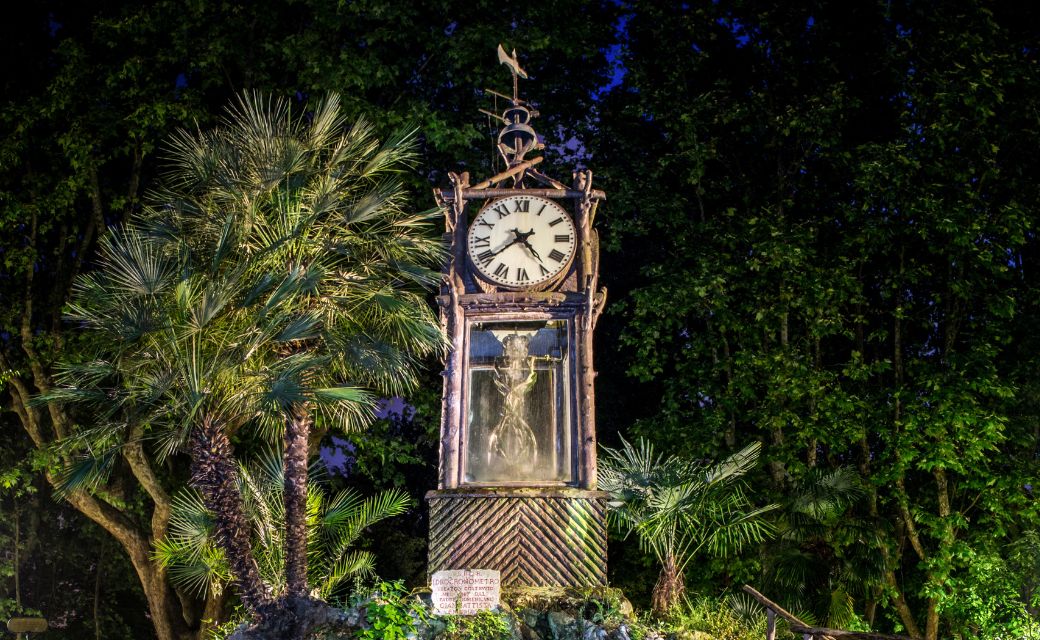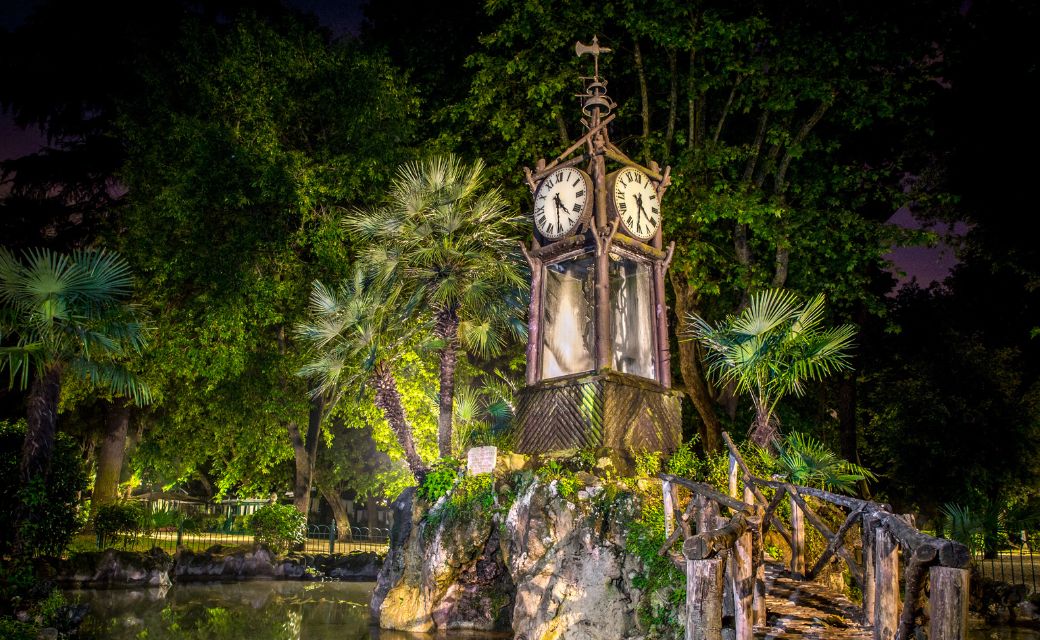

Hidden in Villa Borghese’s leafy gardens, Rome’s Pincio Water Clock looks like a fairytale ornament. Installed in 1873, it tells time using a steady flow of water.
Dominican friar Giovanni Battista Embriaco designed the clock in 1867. A student of mechanics and watchmaking, he devised it to use flowing water as the motor, rather than simply measuring how quickly water drained away.
In 1872, during the city’s Pincio renovations and water-supply improvements, Embriaco offered it to Rome. Architect Gioacchino Ersoch set it in a naturalistic fountain beside a cistern that supplied the park’s lawns and fountains. It was installed the following year.
Now it stands on a tiny island in a pond along Viale dell’Orologio. Its iron tower resembles a tree, with four dials and a glass case around the mechanism. Inside, water fills two leaf-shaped cups balanced on a pin. One tips, empties, and sets the other filling. Their alternating motion powers the hands and chimes, so it needs no winding key. Water is both its engine and a hazard: moisture can corrode its metal parts, while wind can slow or stop it. Peer through the glass to watch this dance of water and gears keeping time in Rome.