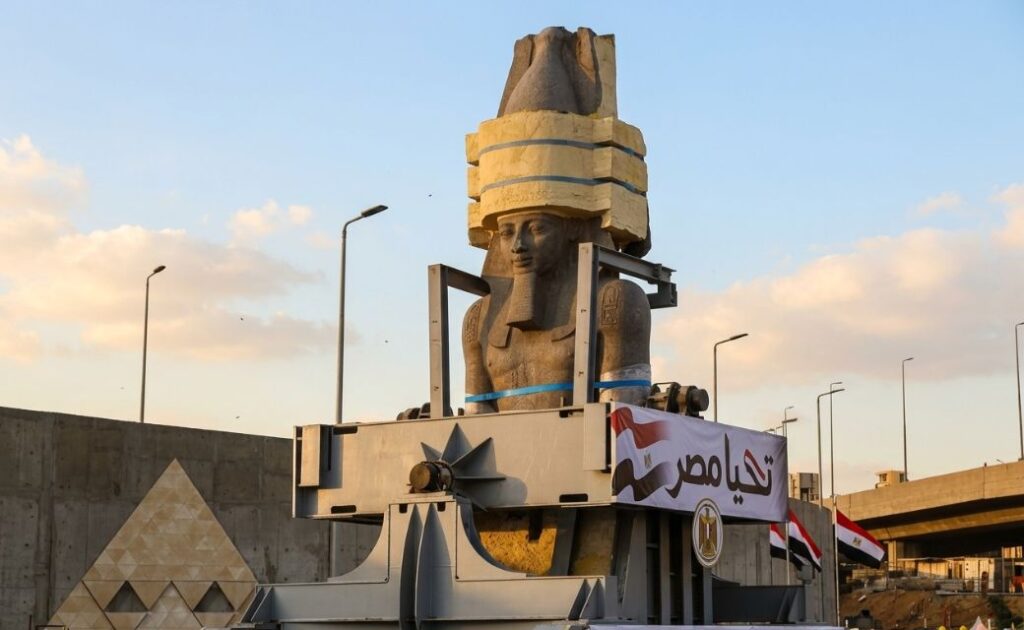
Emerging from centuries of stillness and sand, the colossal statue of Ramesses II tells a remarkable story. Discovered in 1820 near Memphis (then capital of Egypt) by Giovanni Battista Caviglia, the statue was found broken into six pieces, its former grandeur long forgotten.
Reassembling this giant was no easy feat. Early restoration required the careful alignment of massive granite blocks, which were internally reinforced to support their immense weight while preserving the pharaoh’s commanding likeness. In 1955, under Gamal Abdel Nasser, the statue was finally reconstructed and raised once more to stand tall in Cairo as a symbol of national pride in Ramses Square.
Already then, mysteries of Egypt are ever-present… during the restoration process engineers marvelled at the perfect mirrored symmetry of this enormous statue.
Over time, however, pollution and constant urban vibration threatened its stability, prompting a new phase of conservation. With the planned opening of the Grand Egyptian Museum (GEM), the timing felt almost written in the stars. Experts conducted detailed assessments, addressing cracks and erosion, before beginning a 15-year restoration process near Giza.
The 72-tonne, 12-metre-tall colossus made its final 400-metre journey in 2021 into the atrium of the Grand Egyptian Museum, where it now stands illuminated by natural light filtering through the vast glass ceiling—an effect reminiscent of the solar alignment at Abu Simbel, bringing the presence of Ramesses II back to life.