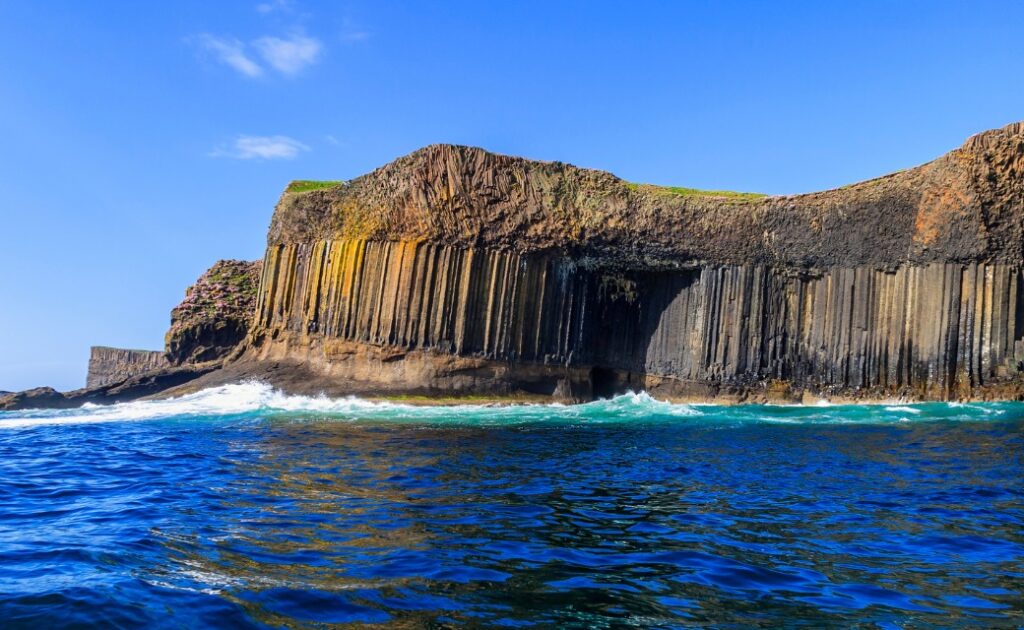
Off the rugged west coast of Scotland on Staffa Island lies Fingal’s Cave, a cathedral-like sea cave carved entirely by nature. Its towering walls of geometric basalt columns rise from the sea like a giant organ, forming one of the world’s most striking natural chambers.
The cave was created around 60 million years ago during intense volcanic activity. Molten basalt surged from deep within the earth and cooled rapidly on the surface. As the lava contracted, it cracked into near-perfect hexagonal columns. Over millennia, the relentless power of the Atlantic hollowed out the cave, producing a symmetrical interior that stretches roughly 70 metres into the island and rises to nearly 20 metres.
When waves crash inside, they echo against the stone, creating haunting, musical sounds that inspired the German composer Felix Mendelssohn to write his famous Hebrides Overture.
For those drawn to legend as much as geology, it’s said Fingal’s Cave was once part of a giant’s pathway across the sea, a place where nature’s precision and myth collide, leaving visitors in awe of its otherworldly beauty.