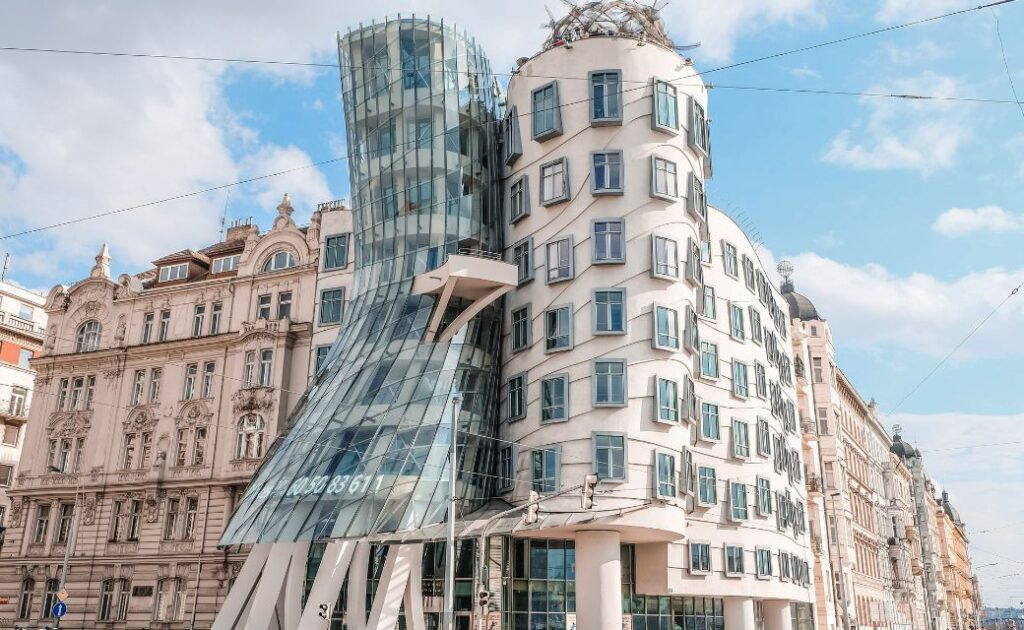
Set on the Vltava River, the Dancing House is a symbol of transformation. Built on a site once destroyed by the 1945 U.S. bombing of Prague, this bold creation reflects the city’s transition from communism to democracy. Architect Vlado Milunić, working alongside his neighbour Václav Havel, conceived the idea as a cultural centre. With backing from Dutch insurer Nationale-Nederlanden, Milunić partnered with renowned architect Frank Gehry to bring the design to life.
Gehry, famous for his deconstructivist style, transformed Milunić’s vision into a striking building. The design is a metaphor for the country’s newfound freedom: “Fred and Ginger,” with the stone tower representing Fred’s strength and the glass tower symbolizing Ginger’s fluidity. The structure’s dynamic form is supported by 99 uniquely shaped concrete panels, with misaligned windows cleverly concealing 2 extra floors.
Gehry’s influence on the world of architecture is immeasurable. His iconic approach, of blending curves and fragmented forms, changed the way architects viewed design, encouraging bold experimentation. The Dancing House, completed in 1996, remains one of his most celebrated works.
Though Gehry recently passed, his legacy lives on in structures like the Dancing House, which continues to challenge convention and redefine the city’s skyline, proving that sometimes, progress comes with a daring twist.