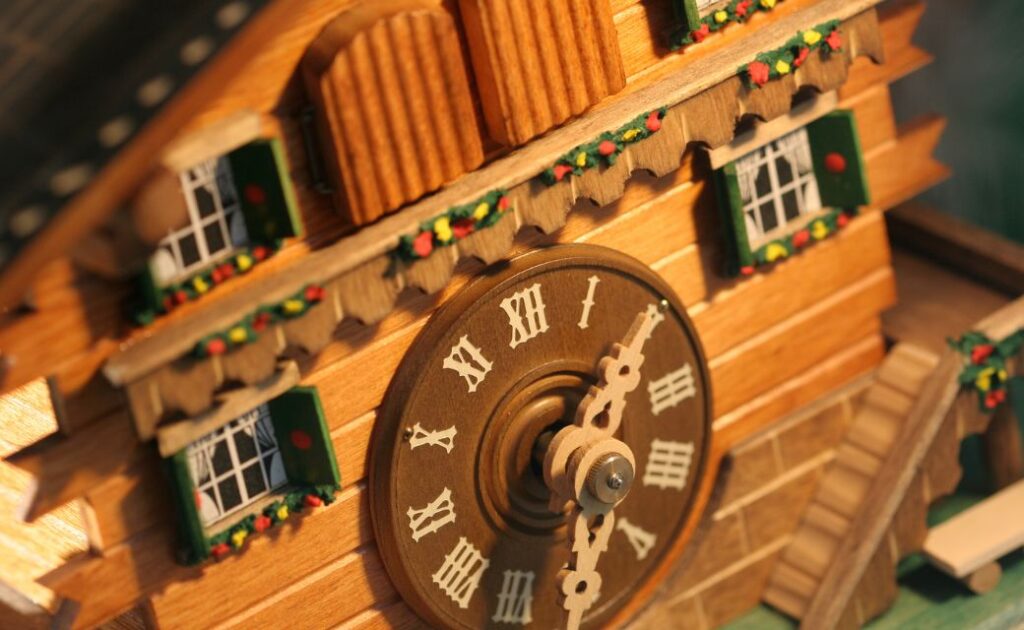
In Germany’s Black Forest, known for its fairytales, a cheerful sound once drifted through farmhouses: the call of a cuckoo bird announcing the hour. The cuckoo clock, now a worldwide icon, first took shape in the early 18th century. While the idea of bird-voiced clocks had appeared earlier, Franz Anton Ketterer of Schönwald is often credited with creating the first true cuckoo clock around 1730.
These clocks were crafted not in factories, but in farmhouses. During long winters, families turned to carving and clockmaking to supplement their farming. Men carved cases from oak or linden, often decorated with vines, birds, or deer. Women painted details, children worked on smaller pieces, and skilled artisans built the mechanisms, wooden gears at first, later brass and iron.
The cuckoo was both clever and practical. At a time when many people could not read a clock’s face, the bird’s call made timekeeping accessible. The sound itself was a mechanical marvel: 2 tiny wooden bellows pushed air through paired pipes, 1 high-pitched and 1 low, producing the familiar “cu-ckoo.” With each hour, a carved bird popped out from its little door. Later models were accompanied by music, dancers, or moving figurines.
By the 19th century, the Black Forest was known as “the land of a thousand clocks,” exporting them across Europe and beyond. From simple house-shaped models to ornate musical designs, the cuckoo clock remains a blend of art, ingenuity, and whimsy, proof that even time can sing.